Why Are American Comics All in Caps? — The Culture of ALL CAPS Born from Printing, Craft, and Cognition
Why Are Comic Books All Caps? The Real Reason Explained
When people decide they want to learn English through comics, many of them run into the same obstacle right away.
Yes—the text somehow feels hard to read.
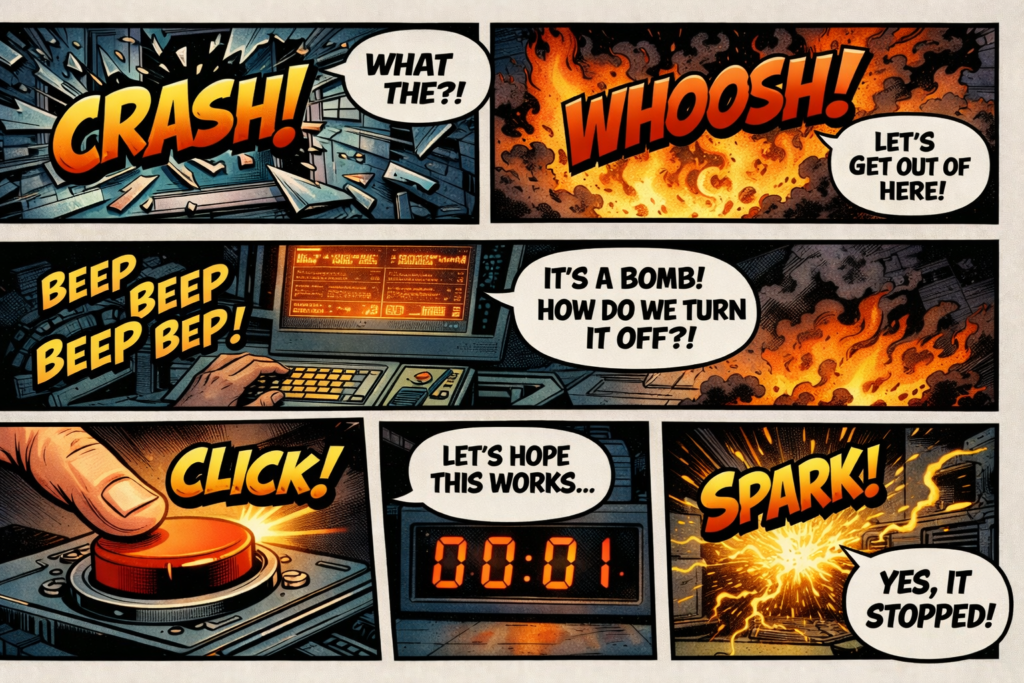
Open a page of American comics—so-called “Amekomi”—and you’ll find that every single line of dialogue is written in uppercase letters—ALL CAPS!
At first glance, it might seem like nothing more than a stylistic quirk. But as you continue reading, you begin to realize that this choice is far from arbitrary; rather, it is the result of a long history and a body of practical wisdom.
In this article, let’s explore the historical reasons why uppercase letters are used in American comics!
The Culture of ALL CAPS Born from Printing, Craft, and Cognition
In the early 20th century, when American comics were first born, the publishing industry was under pressure to produce large quantities at low cost. In an era dominated by cheap paper and crude printing technology, lowercase letters had a critical weakness.
Delicate curves in letters such as “a,” “e,” and “r” would easily blur or fill in due to ink bleeding and misalignment, making them difficult to distinguish.
Uppercase letters, by contrast, have thicker strokes and simpler forms, making them far more resilient even under poor printing conditions. As a writing system that could be read reliably in low-quality environments, uppercase letters were naturally favored. This was not merely a compromise, but a practical and urgent effort to ensure that readers were never left behind.
Moreover, in the production process of the time, dialogue was not set in machine fonts but was hand-lettered, one character at a time, by artisans known as letterers. Here, too, uppercase letters proved overwhelmingly rational.
With all letters sharing the same height, layouts within speech balloons were less likely to break. Writing speed increased, and corrections were easier to make. Introducing lowercase letters would bring in ascenders and descenders—parts of letters that extend above or below the line—reducing efficiency and disrupting visual stability. Uppercase letters thus represented an ideal choice, balancing craftsmanship with production efficiency.
But that’s not all. American comics are a unique medium in which “images” and “words” enter the reader’s mind simultaneously. Within a single panel, the reader must grasp the story in an instant. Uppercase letters make this cognitive process remarkably smooth.
Because there is less variation in letter shapes, recognition becomes faster, and the reader’s gaze flows smoothly through the speech balloon. The uniformity of form creates a consistent reading rhythm. Even in intense action scenes, the words leap into the reader’s eyes in an instant. In this sense, uppercase lettering can be seen as a system perfectly optimized for high-speed reading.
ALL CAPS Elevated into Culture
As time went on and the era shifted, digital fonts became the norm. Yet even now, the convention of ALL CAPS remains unchanged.
Even with the development of specialized fonts such as Comicraft, uppercase lettering continues to be the standard—not for technical reasons anymore, but for cultural ones. What sustains it is a deeply ingrained sense of “this is what comics should look like,” shaped over decades: a shared aesthetic, a readerly familiarity, and an unspoken rule within the production process. Once established, a visual language transcends mere efficiency and comes to live on as a defining sign of the genre itself.
That said, uppercase lettering is not an absolute rule. On the contrary, precisely because it serves as the default, deviations from it create striking expressive effects. Small, thin letters can convey whispers, while bold uppercase can emphasize shouts. At times, uniquely stylized lettering can highlight a character’s individuality. Uppercase functions as a baseline, and by stepping away from it, the texture of emotion and voice can be rendered more vividly.
Viewed in this way, the culture of uppercase lettering in American comics emerges as a refined product shaped over time by three forms of rationality: the constraints of printing, the efficiency of hand lettering, and the cognitive speed of readers. Over time, it has transcended mere functionality and evolved into an aesthetic ideal—what we might call “comic-ness.” The ALL CAPS dialogue we see on the page today is, in a sense, the fully realized form cultivated by the medium’s history.
For those of us unaccustomed to reading text written entirely in uppercase, it may feel somewhat difficult at first. But beneath that surface lies the long history of comics, breathing life into the simple act of delivering words.